ARC Raiders Survival Guide: The Scavenger Protocol (Levels 1-20)
15/02/2026
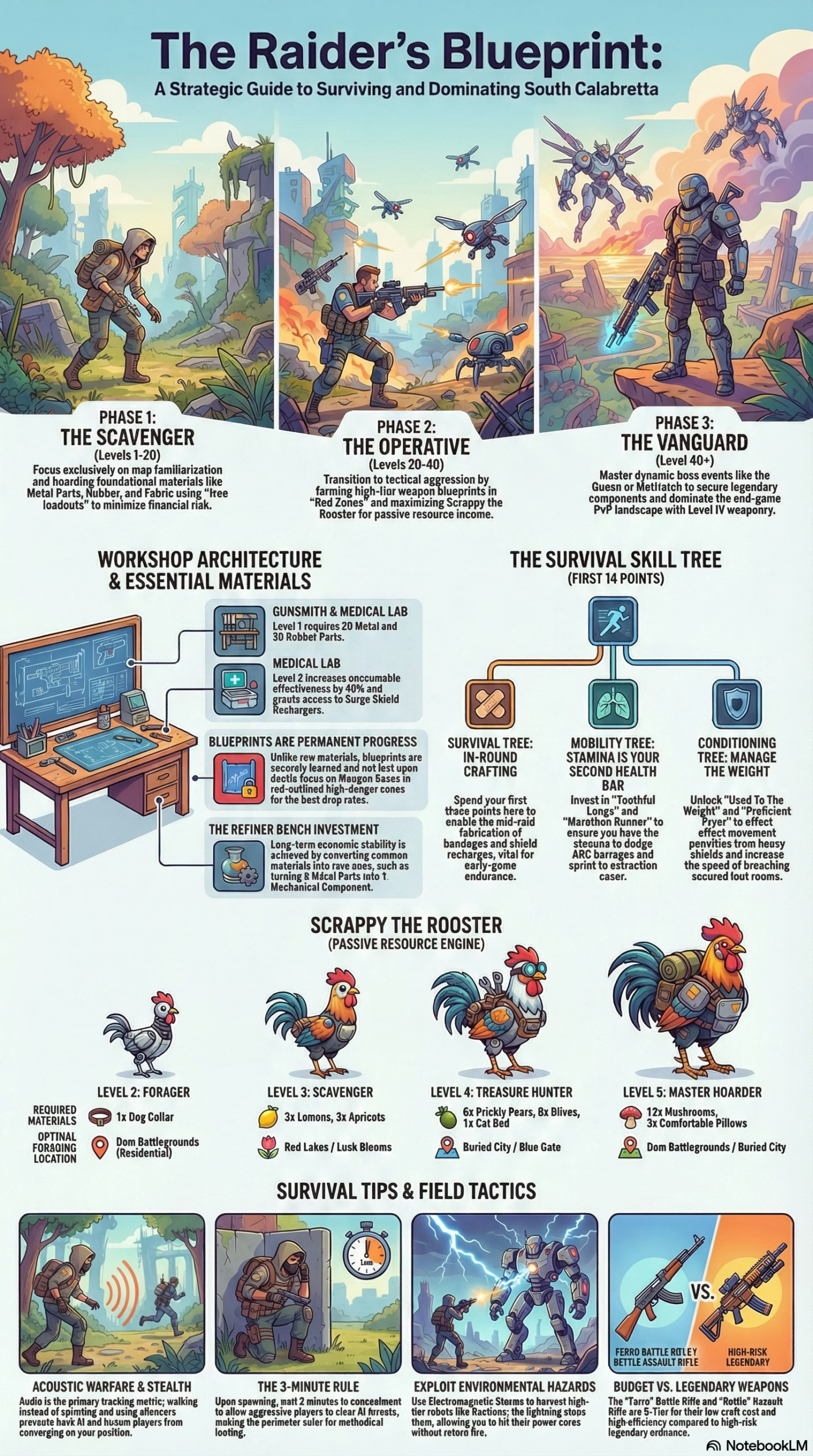

The Level 20 Inflection Point: Why the “Chad” is a Dead Concept
The current discourse surrounding survival in ARC Raiders is often paralyzed by a singular, binary fear: the total loss of gear. However, as we hurtle toward the Level 20 inflection point, the reality is far more nuanced and, arguably, more liberating.
We are not witnessing the end of combat, but the dissolution of the “Aggressor”—the individual whose primary value lies in the manual execution of PvP engagements.
According to the comprehensive “Scavenger Phase” guide, we are entering a period of “massive strategic transformation.” We are shifting away from a world where players force engagements to one where they orchestrate economic efficiency. This isn’t just a change in tactics; it is a fundamental evolution of the survivor’s role within the Dam Battlegrounds. To thrive, we must stop being the “fighters” of the raid and start being its “architects.”
Video Overview
Podcast discussion
From Aggressor to Ghost
The transition from “Aggressor” to “Scavenger” represents a profound shift in operational psychology. In this new paradigm, players no longer perform high-risk tasks like perimeter patrols or spawn rushing. Instead, they manage complex loops of “Stealth Economics”—autonomous behaviors capable of navigating high-heat zones to achieve high-level financial objectives.
During the first 20 levels, you are “made of glass.” Death strips you of carried gear, so you must minimize risk. By offloading the aggressive clearing of AI to other players, the Scavenger is elevated to a position of safety. Audio is your primary metric of exposure. Sprinting broadcasts your location to both machines and “Rats.” To succeed, you must adopt the “Silencer Meta”—a Silencer III reduces noise by 60%, effectively rendering you invisible to AI detection.
This strategic patience allows you to focus on the “where” and “when” of looting, while the “risk” is handled by aggressive players eliminating each other.
The Architect of Value: The Rise of the Economic Scavenger
As we integrate these survival systems, a mission-critical rule has emerged: the 3-Minute Rule.
This rule is the primary defense against “spawn rushing” and the phenomenon of early-raid wipes. When you spawn, wait in absolute concealment. The Scavenger acts as the “Architect of Value,” establishing the high-level patience required to keep your survival rate within the bounds of profitability.
This patience feeds directly into the Kitbash Economy. In Speranza, “Cred” is merely a vehicle for reputation. Your true net worth is determined by your relationships with the syndicate:
- Celeste: The entry point. She converts seeds and basic organics into foundational materials.
- Shani: The Security Chief. She is the only source of Raider Hatch Keys, the most critical item for ensuring a safe extraction away from the public beacons.
- Tian Wen & Apollo: The arms dealers. Do not approach them until you have stabilized your economy.
“The primary function of the Scavenger is to ‘actively manage, audit, and ensure the retention of the underlying resource ecosystem.'”
Eliminating Gear Fear: The Free Loadout Strategy
The greatest barrier to progression maturity is that player economy is currently “hopelessly fragmented.” Most beginners suffer from resources trapped in expensive loadouts that vanish upon death. This friction is the enemy of base building.
The Scavenger utilizes “Free Loadouts” to physically bridge the gap between poverty and sustainability. By trading “Free Loadout Augments” to Lance at the Clinic for medical items and shields, you transform a liability into an asset. Without this unified foundation, even the best aim is merely an engine without fuel.
To maximize this, rely on the S-Tier Economy Kings—weapons that offer high lethality for low investment:
- The Ferro (Battle Rifle): Uses cheap heavy ammo and shatters armor. It is the most cost-effective tool for removing AI threats.
- The Anvil (Hand Cannon): Functions as a pocket shotgun. It provides massive damage output for a sidearm slot, perfect for defensive plays.
The New Economy of “Survival Capital”
As the “Scavenger” masters the avoidance of conflict, human value is being redefined as “Survival Capital.” This is the synergy of optimal skill tree distribution and advanced map knowledge that are fundamentally non-combat.
To build your Survival Capital, you must focus on standardized skill points that pure shooters often ignore:
- In-Round Crafting (Red Tree): Mandatory for crafting bandages and grenades mid-raid. Without this, you bleed out.
- Looter’s Instincts: Reduces container search time, minimizing the seconds you are vulnerable.
- Broad Shoulders: Increases carry weight. Being over-encumbered makes you an easy target.
- Marathon Runner & Youthful Lungs: Stamina acts as a second health bar; maxing it is essential for escaping ambushes.
The goal of this transition is for us to become “faster looters, quieter movers, and better survivors.” These “soft” skills are, in fact, the hardest to master and the most valuable “capital” a raider can possess in a high-stakes economy.
Operational Theaters: Analyzing Risk Profiles
Survival Capital is useless without proper application. South Calabretta is divided into distinct zones, each requiring a specific risk calculation.
The Dam Battlegrounds (Entry Level)
Defined by waterlogged industrial zones, this is the S-Tier location for farming Metal Parts and ARC Alloy. The visual cover provided by the swampy terrain makes evasion easier for the solo Scavenger. Focus on the Electrical Substations for batteries.
Buried City (High Risk / Vertical)
Known as “Rat Heaven,” this area consists of tight urban alleyways. While dangerous, it is the primary source of Cat Beds and Pillows—obscure but essential items for base upgrades. The verticality here favors the patient; avoid street level at all costs.
Acerra Spaceport (Extreme Lethality)
A sniper’s paradise characterized by massive open tarmacs. While it holds high-tier blueprints, the Launch Towers are lethal zones. Only approach this area if you possess smoke grenades to screen your movement.
The Workshop Dividend and the Phase 2 Vision
The economic implications of this shift are staggering. Proper management of the Workshop is projected to unlock exponentially higher survival odds. This surge in productivity offers a unique opportunity to redesign the human experience of the raid:
- Gunsmith Station: Upgrade to Level 1 immediately (20 Metal Parts, 30 Rubber Parts) to stabilize recoil. Push for Level 3 to unlock Silencers.
- Medical Lab: Level 2 grants access to Defibrillators and Surge Shield Rechargers, increasing consumable effectiveness by 40%.
- Scrappy the Rooster: This is your passive income generator. Locate a Dog Collar in the residential sectors (Buried City) to upgrade Scrappy to Level 2 (Forager). At Level 5, Scrappy requires “Very Comfortable Pillows,” but will generate a constant stream of Metal, Rubber, and Fabric.
Conclusion: Reclaiming the Human Advantage
We are moving away from an era where success was defined by K/D ratios. In the age of the Scavenger, our value is found in our “Economic Advantage”: the ability to provide oversight, patience, and strategic vision to a hostility-filled environment.
The transition from Aggressor to Scavenger is not a loss of agency, but a reclamation of it. As you look toward Level 20, the defining question of your career will not be which weapon you can shoot, but how much “ARC Alloy” you have banked.
How are you investing in your unique survival skills today to lead the raids of tomorrow?