The Evolution of Knowledge Work: A Timeline from 1800 to 2040
15/02/2026
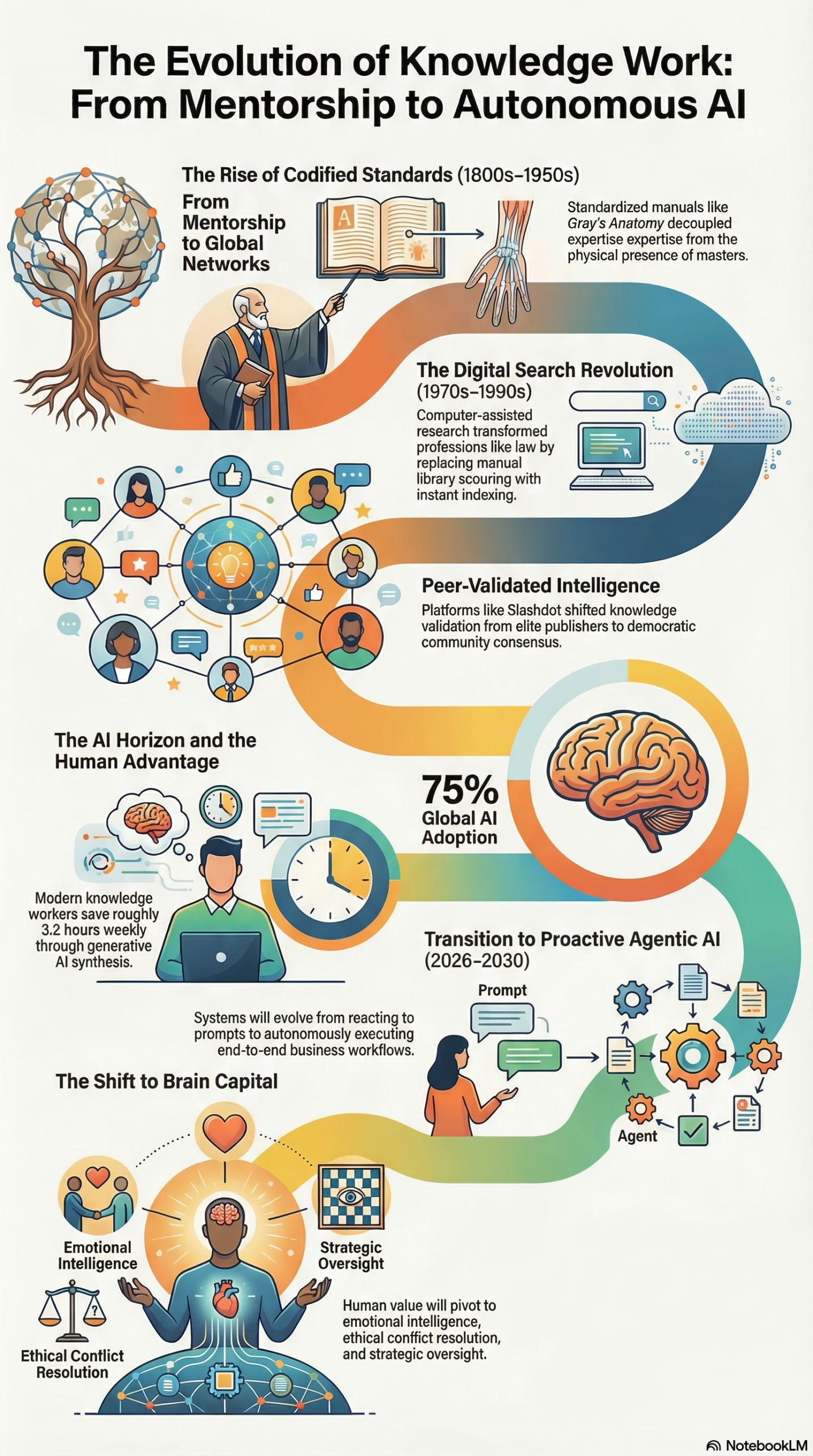

From Apprenticeships to AGI: The 7 Epochs of Knowledge Work
The term “knowledge worker” was popularized by Peter Drucker in 1968 to describe a massive macroeconomic shift: the transition from an industrial society powered by manual labor to one driven by intellectual capital. But how do these workers actually acquire, store, and use that knowledge?
A new analysis suggests this history is best understood as a process of “cognitive externalization”—a centuries-long journey of moving knowledge out of our heads and into tools, networks, and now, autonomous systems.
Here is the evolutionary timeline of how we learned to think outside the brain.
Video Overview
Podcast discussion
Interactive web page: Knowledge Evolution Timeline
Epoch I: The Artisanal Paradigm (Pre-1800s)
The Era of “Learning by Doing”
For most of human history, professional knowledge was “tacit”—locked inside the human mind and transferred only through physical proximity. Whether it was Egyptian scribes or medieval blacksmiths, the primary mechanism for learning was the master-apprentice relationship.
- The Constraint: Knowledge transfer was bottlenecked by the master’s lifespan and location. If you didn’t live near a master, you didn’t learn the trade.
- The Dynamic: Proprietary guild secrets passed down through years of hands-on mimicry.
Epoch II: The Typographical Era (1800s–Mid 1900s)
Scaling Truth via the Printed Page
The steam-powered printing press disrupted the artisanal model by allowing knowledge to scale asynchronously. This era saw the rise of the “Standardized Manual.”
- The Medical Revolution: In 1858, Henry Gray published Anatomy: Descriptive and Surgical (now Gray’s Anatomy), creating a “doctor’s bible” that standardized medical education.
- Engineering Precision: As the Industrial Revolution demanded mathematical rigor, “rules of thumb” were replaced by comprehensive reference texts like Kent’s Mechanical Engineer’s Pocket-Book (1895).
- The Downside: While books democratized information, they also codified social hierarchies, with 19th-century “age manuals” frequently reinforcing gender biases under the guise of scientific fact.
Epoch III: The Digital Dawn (1970s–1990s)
From Stacks to Search
As physical handbooks became too heavy and outdated to manage, the digital revolution began. This epoch was defined by the transition from physical pages to electronic retrieval.
- Legal Tech Pioneers: Lawyers were among the first to ditch the library stacks. The launch of Lexis (later LexisNexis) allowed attorneys to search case law in minutes rather than days, fundamentally disrupting the “billable hour” model.
- The Search Engine Arms Race: The 90s saw a rapid evolution from directory-based tools like Archie (1990) to full-text algorithmic engines like Google (1998), turning the chaotic web into a navigable repository.
Epoch IV: The Networked Web (1980s–2000s)
The Rise of Peer-to-Peer Knowledge
While corporations tried to hoard knowledge in top-down databases, a grassroots ecosystem flourished. Knowledge became something generated collaboratively by the “crowd”.
- Corporate Groupware: Lotus Notes (1989) revolutionized enterprise collaboration with high-security encryption and the first widely used “replicated” databases.
- The Digital Watercooler: Communities like USENET and Slashdot introduced peer-validation, where the quality of information was determined by community consensus rather than elite gatekeepers.
Epoch V: Specialized Social Networks (2000s–2010s)
The Walled Gardens of Expertise
As the web grew noisier, professionals migrated to “walled gardens”—verified, niche networks designed for specific regulatory environments.
- Healthcare Hubs: Platforms like Sermo and Doximity allowed physicians to crowdsource diagnoses in HIPAA-compliant environments, bypassing the slowness of traditional journals.
- Living Knowledge: Professional knowledge was no longer a static asset in a book, but a dynamic, real-time stream of verified intelligence.
Epoch VI: The Algorithmic Era (2020s–Present)
Synthesizing “Knowledge Chaos”
We are currently living through the most significant disruption since the printing press: Generative AI. Instead of searching for documents, workers now use LLMs to synthesize answers instantly.
- The Productivity Boom: Data indicates that AI users save roughly 2.2 hours per week, with 93% of AI-heavy executives now considering a four-day workweek.
- The New Challenge: The ease of generation has led to “knowledge chaos,” where AI hallucinates based on fragmented corporate data. This has created a new role: the AI Knowledge Curator, responsible for auditing the data ecosystems that feed the algorithms.
Epoch VII: The Autonomous Horizon (2030–2040)
The Future of Brain Capital
Looking ahead, the report projects a shift to Agentic AI—systems that don’t just answer questions but autonomously execute multi-step workflows.
- The Prediction: By 2028, models may achieve expert-level reasoning across all professional domains.
- The Human Role: As AI automates retention and analysis, human value will pivot to “Brain Capital”—emotional intelligence, ethical conflict resolution, and strategic foresight.
This post is based on the research report “Knowledge Work: A Timeline”.