Beyond the Machine: Architecting Your Career in the Age of Brain Capital
15/02/2026
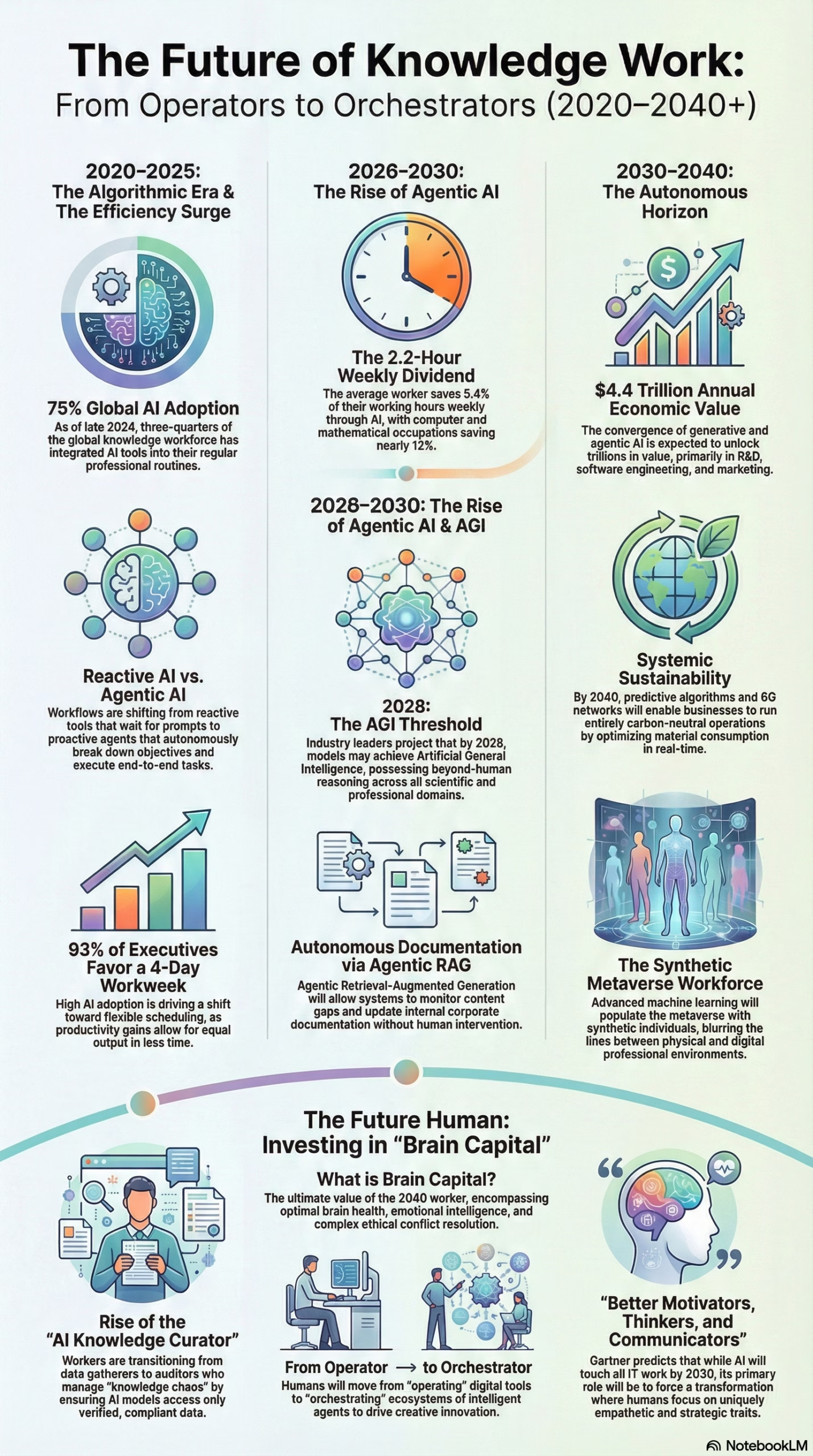

The 2028 Inflection Point: Why the “Operator” is a Dead Concept
The current discourse surrounding Artificial Intelligence is often paralyzed by a singular, binary fear: the total erasure of the human worker. However, as we hurtle toward a 2028 inflection point, the reality is far more nuanced and, arguably, more liberating.
We are not witnessing the end of work, but the dissolution of the “Operator”—the individual whose primary value lies in the manual execution of digital tasks.
According to the “Knowledge Work” report, we are entering a period of “massive workforce transformation.” We are shifting away from a world where humans operate tools to one where they orchestrate autonomous agents. This isn’t just a change in job descriptions; it is a fundamental evolution of the human role within the digital ecosystem. To thrive, we must stop being the “hands” of the organization and start being its “architects.”
Video Overview
Podcast discussion
From Tool-User to Ecosystem Orchestrator
The transition from “Operator” to “Orchestrator” represents a profound shift in organizational psychology. In this new paradigm, humans no longer perform granular tasks like basic data entry or routine coding. Instead, they manage complex ecosystems of “Agentic AI”—autonomous systems capable of navigating entire workflows to achieve high-level business objectives.
By 2028, AI is predicted to create more jobs than it destroys, but only for those who embrace the “collaborative partner” model. This shift is fundamentally empowering. By offloading the computational and repetitive drudgery to silicon, the worker is elevated to a position of strategic oversight.
This cognitive synergy allows humans to focus on the “why” and “how” of a business, while the “what” is handled by intelligent agents.
The Architect of Truth: The Rise of the AI Knowledge Curator
As we integrate these autonomous systems, a mission-critical role has emerged: the AI Knowledge Curator.
This role is the primary defense against “knowledge chaos” and the phenomenon of AI “hallucinations.” When Agentic AI is fed poor, unverified data, the results are not just wrong—they are potentially catastrophic. The Curator acts as the “Architect of Truth,” establishing the high-level governance required to keep AI systems within the bounds of reality and ethics.
“The primary function of an AI Knowledge Curator is to ‘actively manage, audit, and ensure the ethical compliance of the underlying data ecosystems.'”
Eliminating Knowledge Chaos: The eGain Strategy
The greatest barrier to AI maturity is that institutional information is currently “hopelessly fragmented.” Most large organizations suffer from data trapped in silos: disparate SharePoint sites, legacy CRMs, and outdated PDF manuals. This fragmentation is the enemy of automation.
The AI Knowledge Curator utilizes “AI Knowledge Hubs” to physically bridge these silos into a single, verified source of truth. By unifying these disparate data streams, the Curator transforms a liability into an asset. Without this unified foundation, even the most advanced AI is merely an engine without fuel.
The New Economy of “Brain Capital”
As AI masters the analytical and retentive aspects of work, human value is being redefined as “Brain Capital.” This is the synergy of optimal brain health and advanced cognitive skills that are fundamentally non-algorithmic.
To build your Brain Capital, you must focus on five uniquely human traits that machines cannot replicate:
- High-level Emotional Intelligence: Navigating the complex, often irrational dynamics of human behavior.
- Complex Ethical Conflict Resolution: Managing moral gray areas where there is no “correct” statistical answer.
- Motivational Leadership: Inspiring teams and driving human performance through shared purpose.
- Empathetic Communication: Building deep, authentic connections that facilitate trust.
- Creative Strategic Foresight: Envisioning future possibilities that go beyond simple statistical predictions of the past.
The goal of this transition is for us to become “better motivators, better thinkers, and better communicators.” These “soft” skills are, in fact, the hardest to automate and the most valuable “capital” a worker can possess in an AI-driven economy.
The $4 Trillion Dividend and the 2040 Vision
The economic implications of this shift are staggering. Generative and Agentic AI are projected to unlock between $2.6 trillion and $4.4 trillion in annual economic value. This surge in productivity offers a unique opportunity to redesign the human experience of work:
- Reduced Burnout: AI is expected to save approximately 12% of work hours in high-exposure sectors.
- The 4-Day Workweek: Currently, 93% of executives at high-adoption companies favor a four-day workweek.
- Sustainability: By 2040, AI is expected to drive carbon-neutral operations by detecting real-time inefficiencies.
Conclusion: Reclaiming the Human Advantage
We are moving away from an era where humans were defined by their ability to gather and process data. In the age of the Orchestrator, our value is found in our “human advantage”: the ability to provide oversight, ethical judgment, and strategic vision to a network of intelligent machines.
The transition from Operator to Orchestrator is not a loss of agency, but a reclamation of it. As we look toward 2028, the defining question of your career will not be which tools you can use, but how much “Brain Capital” you have built.
How are you investing in your uniquely human skills today to lead the agents of tomorrow?